Holidays

5 02, 2018

A Wordless Love Story – February 2018 Update

By |2018-02-01T10:35:19-06:00February 5th, 2018|Holidays, Make Me Think Monday|2 Comments

On February 4, 2013, I originally posted this blog about a six-minute animated film that mixes hand-drawn and CGI animation to tell a love story

Unfortunately, the YouTube video I chose is no longer available. You can, however, watch this Disney trailer.

The Disney Animation video premiered at the Annecy International Animated Film Festival in June 2012 and won the Best Animated Short Category at the 2013 Academy Awards.

As a romance writer, I think Paperman does a fabulous job of telling a wonderful love story without using a single spoken word. It’s the perfect blog for the beginning of February, which is why I’ve revised my original 2013 blog and am posting again this year.

Enjoy as you prepared for this month of love.

15 01, 2018

It’s Martin Luther King Day

By |2018-01-14T15:32:54-06:00January 15th, 2018|Holidays, Make Me Think Monday|2 Comments

Martin Luther King’s calm civil disobedience and charismatic leadership inspired men and women, young and old, here and around the world.

He inspired so many that, in 1964, he was awarded the Nobel Peace Prize – the youngest man to receive the prestigious honor.

Through his lectures and dialogues, he stirred our conscience. His words continue to be as meaningful today.

President Ronald Reagan signed legislation in 1983 to establish a yearly federal holiday to honor the man and his accomplishments. Today has been designated as that day.

As you honor Dr. King today, pause and consider these MLK quotes.

On Leadership

“The ultimate measure of a man is not where he stands in moments of comfort and convenience, but where he stands at times of challenge and controversy.”

On Love

“I have decided to stick with love. Hate is too great a burden to bear.”

On Getting Along

“We may have all come on different ships, but we’re in the same boat now.”

On Faith

“Our scientific power has outrun our spiritual power. We have guided missiles and misguided men.”

On Service

“Everybody can be great … because anybody can serve. You don’t have to have a college degree to serve. You don’t have to make your subject and verb agree to serve. You only need a heart full of grace. A soul generated by love.”

Additional legislation passed in in 1994 establishing Martin Luther King Day of Service to encourage citizens to use the federal holiday as an opportunity to give back to their communities. Why not let this MLK Day be the start of a year in which you make a positive impact?

25 12, 2017

The Christmas Scale – Joy to the World

By |2017-12-03T09:58:42-06:00December 25th, 2017|Holidays, Make Me Think Monday|1 Comment

This is my all-time, very-favorite Christmas video. Since I post it every year, I guess you figured that out.

If you have a piano around round your house, try playing the C scale. Start on middle C and play up to the next C. Then play back down the scale again. Start on the 8th note and pause on the 1st note, 2nd, 4th, 6th, 7th and 8th.

Listen as you play. What you’ll hear is the good news for Christmas .

 “Joy to the World! The Lord is Come.”

Chicken Wrangler Sara and I will be back in January. Enjoy a wonderful Christmas week with your family and friends.

Merry Christmas!

22 12, 2017

Nativity Scenes

By |2017-12-21T09:56:38-06:00December 22nd, 2017|Friday on the Miller Farm, Holidays, Miller Farm Friday|2 Comments

A Blog by Chicken Wrangler Sara

I began collecting nativity scenes before the birth of our first child, Catherine. Beekeeper Brian was selling pens at craft fair booth and traded a pen for a wooden nativity set.  We thought it would be something our child could safely enjoy.  I also made a cloth set which has since gone to live with Catherine.

Our collection includes a plaster of Paris piece which I painted at a vacation Bible School when I was in elementary school and another clay set Matthew made in junior high.

The one I brought back from our time in Mexico is painted tin and very light weight.  As such, it tends to fall over and last year I didn’t set it out.  This year I hadn’t made a decision about it but the grandmother of a piano student from Mexico saw it and lovingly bent each piece so it would stand upright.And they are still standing.

Each time I walk past the coffee table, I remember her kneeling and arranging each piece of the nativity.  It is amazing to think that the birth of a child so many years ago still has an impact on people today.

20 12, 2017

Christmas Vocabulary – Deck the halls

By |2022-12-10T16:26:16-06:00December 20th, 2017|Holidays, Wednesday Words|2 Comments

This Christmas phrase is easy to understand. When you say, “It’s time to deck the halls,” you mean putting out holiday decorations.

But did you realize the phrase can be traced back to a 16th-century Welsh drinking melody?

In 1862 Thomas Oliphant, a Scottish musician penned the English-language lyrics from that Welsh tune into the familiar yuletide carol we sing today.

Deck the hall with boughs of holly,
Fa, la, la, la, la, la, la, la, la!
‘Tis the season to be jolly,
Fa, la, la, la, la, la, la, la, la!
Fill the meadcup, drain the barrel,
Fa, la, la, la, la, la, la, la!
Troul the ancient Christmas carol,
Fa, la, la, la, la, la, la, la!

The first line explains why decking the halls means to decorate or adorn. In the 18th and 19th century homes were literally adorned with holly branches and other greenery like ivy and mistletoe at Christmastime because it was festive and readily available.

Many also believed the boughs of holly brought good luck and, from the time of Celtic Christians, Christmas holly’s prickly leaves were a reminder of the crown of thorns Jesus wore at his Crucifixion. The red berries symbolize His blood giving a religious emphasis to the Christmas decorating.

Today, glass ornaments, lights, blow-up yard art, and other adornments join with fresh greenery when we deck our halls.

But, I’m guessing, at one time of another while we’re decorating we hum, or sing, the words to Deck the Halls.

18 12, 2017

Cardinal Sightings

By |2017-12-17T15:55:08-06:00December 18th, 2017|Holidays, Make Me Think Monday|1 Comment

We see cardinals are everywhere during the holiday season—on Christmas cards and holiday wreaths and nestled in decorations. If you’re fortunate enough, you might catch a glimpse of one outside.

The female is a soft, warm tan color with a bright orange bill and red edging to the wings and tail while the males are the vibrant red. Non-migratory birds, they remain in an area all their lives and they mate for life.

Our bird-friendly yard provides many cardinals to watch. Their brilliant color, musical songs, and dedication to their mates have always intrigued me.

Watching males gently offer seeds to the female in a kiss-like gesture warms my romance writer heart.

Cardinals have long been symbolic of beauty in the midst of darkness, hope in the midst of sorrow, and renewal in the midst of winter. There is an old folklore saying that, “When a cardinal appears in your yard, it’s a visitor from heaven.”

When you consider the word cardinal comes from the Latin word cardo, meaning hinge or axis, it’s not too far-fetched to see why many cultures believe a cardinal is the doorway hinge who carries messages back and forth between our Earthly world and the Spirit world.

Choctaw tribes believe a sighting is a relationship omen. If you’re single, seeing a cardinal could be a sign your status is about to change. Or, if your relationship is in trouble, a cardinal sighting is a warning that things need to change.

Other Native American cultures believe cardinals help predict changes in the weather, serve as watchers and guardians, or provide a sign of what direction to travel or follow. Their red is believed to offer protection from enemies and illness.

The Native American shaman medicine wheel includes the four sacred (or cardinal) directions: north, south, east and west, and the four cardinal colors: red, blue, black and white. The color red is associated with the East on the medicine wheel. Words spoken toward the East are said to be carried on wings and delivered directly to the Spirit.

Wherever the symbolic meanings come from, the chirp of the brilliant colored male is hard to ignore when he’s trying to gain your attention. Maybe he is signaling a message.

Or, maybe he’s simply saying, Merry Christmas.

13 12, 2017

Christmas Vocabulary – Meet Me Under the Mistletoe

By |2017-12-14T13:51:04-06:00December 13th, 2017|Holidays, Wednesday Words|1 Comment

Mistletoe has always been a magical, mysterious, and sacred plant of folklore since the time of the Druids. This Christmas phrase refers to a tradition of kissing under a sprig of mistletoe that probably dates to the ancient winter festival Saturnalia.

In Victorian times, kissing under the mistletoe signaled a marriage proposal. When all the berries were gone from the original sprig, there could be no more kissing. If a girl remained unkissed at the end of the evening, she could not expect to marry the following year. Christmas mistletoe was then burned on Twelfth Night lest all those who did kiss under it never marry.

Another mistletoe kissing tradition dictates that a person standing under a ball of mistletoe cannot refuse to be kissed. Such a mistletoe kiss could mean deep romance or lasting friendship and goodwill.

On the other hand, when a couple in love  kiss under the mistletoe, it is seen as a promise to marry, as well as a prediction of happiness and long life.

The interesting thing is that a mistletoe plant is actually a parasitic and eating any part of it can cause poisoning. That’s why you find artificial mistletoe used in kissing balls today.

I love the romantic idea of meeting under the mistletoe for a kiss. Would you expect less from a romance writer?

To encourage the tradition, I decorate with two artifical mistletoe balls during the holidays. One is a very old plastic bell and the other a silk ball.

Whether you believe all the folklore or not, mistletoe balls can make for fun at Christmas celebrations when someone whispers “Meet me under the mistletoe.”

11 12, 2017

Christmas Music – the Customs and Traditions

By |2017-12-03T07:05:52-06:00December 11th, 2017|Holidays, Make Me Think Monday|1 Comment

Christian tradition and the liturgical Church calendar recognize the Christmas season from sundown on December 24 (Christmas Eve) through Epiphany of the Lord (January 6). Most of us celebrated the single day, December 25.

Songs of the season are a different story. Christmas music runs non-stop through store speakers beginning after Halloween. Satellite stations and cable networks devote channels to holiday-themed music and shows beginning at Thanksgiving.

For some that’s a good thing. For others, it’s too much. Personally, I’d prefer some Christmas carols and contemporary Christmas songs throughout the year instead of the over saturation.

There was a time before the fourth century when there were no Birth-of-Christ hymns. A songbook with carols only appeared after Christmas was formalized as a feast and fixed to Dec. 25.

In the 13th century, St. Francis of Assisi organized nativity pageants featuring real hay, real animals, and, for the first time, real narrative songs. Christmas singing took on a life of its own, beyond the constraints of the sacred feast. Even drinking songs (much to the church’s horror) contained Yuletide lyrics.

Christmas celebrations and caroling died with the Puritan movement when Cromwell’s Parliament banned any secular observances under threat of fines. The restrictions crossed the Atlantic and settlers of the Massachusetts Bay Colony restricted Christmas caroling and festivities too.

The popularity of Charles Dickens’ A Christmas Carol struck down the grim, Puritan-inflected holiday and led to the 20th century festive, secular tunes. One of the most popular of those songs is “White Christmas,” composed in 1940 by Jewish Irving Berlin, who did not much care for the holiday.

white-christmas Berlin’s tune, Bing Crosby’s rendition, and the 1954 movie by the same title ushered in carols, songs, and theatrical productions appealing more to the Yuletide mood than to the holiday itself.

Others holiday songs like  “Rudolph, the Red-Nosed Reindeer,” “Rockin’ Around the Christmas Tree,” and “Have a Holly, Jolly Christmas” followed. New versions of these old songs, secular and traditional, quickly emerged.

Whether we want to or not, we find ourselves humming or singing along with the old-fashioned melodies.
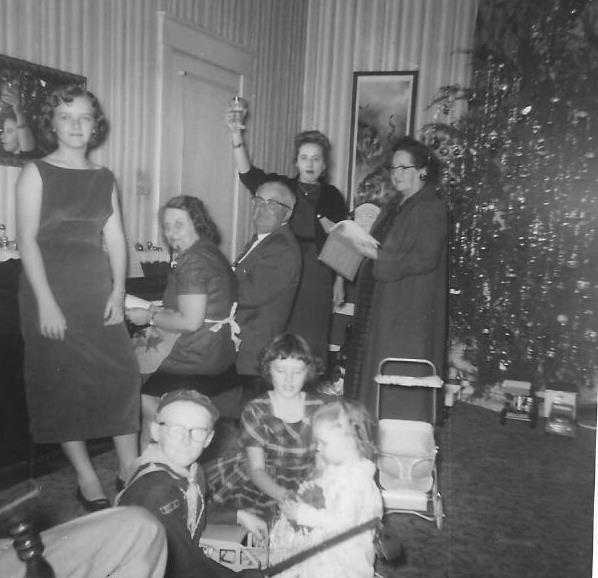
One of our family Christmas traditions was to gather around the piano and sing carols from the church hymnal.  A tradition that now includes other instruments.

Christmas music listeners might distinguish between sacred songs (those with lyrics about Christ’s birth) and secular ones (Santa Claus, snowmen, mistletoe, elves, etc.) If you go wassailing or caroling, you make conscious choices on what to sing.

Whatever lyrics you choose, Christmas music anchors us in the past —before Shakespeare and Beowulf and all the eras in between—and fills us with the spirit of Christmas.

What’s your favorite Christmas song or carol?

8 12, 2017

An Early Gift

By |2017-12-07T08:26:40-06:00December 8th, 2017|Friday on the Miller Farm, Holidays, Miller Farm Friday|4 Comments

A Blog by Chicken Wrangler Sara

One of the nice things about living in one place for a long time is maintaining friendships. 

My friend Greta and I have known each other since our oldest children were in elementary school. These “kids” are now 24.  We have laughed and cried together many times.  We still do.

Greta has gotten chickens from us and supplies fruit and vegetable scraps to both flocks. I bring surplus food to her from the volunteer work I do. 

Last Saturday, upon returning from an early morning meeting, I discovered that Greta had dropped off a bag but not for the chickens. 

It was a gift bag and in it were two pair of slippers – one for me and one for Rachel. They are wonderful!I love the slippers especially now that the weather has turned cold. However, I value the gift of friendship most of all.


30 10, 2017

Where did Halloween come from?

By |2017-10-05T10:20:13-05:00October 30th, 2017|Holidays|0 Comments

Halloween’s origin dates to The Celts, who lived 2,000 years ago in Ireland, United Kingdom, and France.

Celts believed the boundary between worlds of the living and the dead became blurred the night before their New Year, which is November 1st.

On October 31st they celebrated the festival of Samhain, lit bonfires, and wore costumes to ward off roaming ghosts.

In the eighth century Pope Gregory III designated November 1st as a time to honor all saints and martyrs and incorporated some Samhain traditions.

October 31st became All Hallows’ Eve and eventually Halloween, the secular, community-based events filled with craved pumpkins and trick-or-treat, that we celebrate today.

But why crave pumpkins?

An Irish myth about an old drunk called “Stingy Jack” is said to be the reason.

Can you guess why he was called stingy? Of course, because he never wanted to pay for his drinks.

Read the full story here or watch to the fun, spooky video below:

The Irish used turnips, rutabagas, gourds, potatoes and beets for their lights to keep Stingy Jack away and ward off evil spirits on All Hallow’s Eve. Pumpkins became the jack-o-lanterns when waves of Irish immigrants came to America to escape the Potato Famine. They quickly discovered that pumpkins were bigger and easier to carve out.

Oh, and one more tidbit of information about jack-o-lanterns. This advice comes from the antique dealer me, not the Irish storyteller. Be careful where you display your cleverly carved jack-o-lanterns. The base of a pumpkin can stay moist for days and will rot and stain wood or even marble. Put either foil or a dish with a raised edge under any pumpkins or gourds you display this fall. I’ve stained more than one old piece of furniture decorating for fall with gourds and tiny pumpkins.

Go to Top