writing

29 06, 2017

Creativity Innate or Learned

By |2017-06-04T15:19:10-05:00June 29th, 2017|Guest blogger, writing|2 Comments

Help me welcome guest blogger Jack Milgram. Jack is a blogger at Top-notch study tips for A+ students. Today he shares his ideas about creativity.

Creativity Innate or Learned

Creativity is a popular characteristic that you can spot on almost every resume. But what is it exactly? And are we born with this trait, or do we develop it?

From a young age, we’re assured that creativity is a talent you either have or don’t. What does creativity mean? It’s easy—if children can draw or play music, they’re creative; if not, well, they’re good at something else.

Kind of rough, isn’t it?

Now, as adults, we can see that almost everything depends on the effort and time we spend to learn a skill. And the same is true about creativity!

Creative thinking is a combination of effort, genetics, and social environment. But the point is this—if you haven’t found success with the last two, you can always still start developing  creativity.

Firstly, let’s talk about the creativity definition. Creativity is the ability to develop new ideas and solutions. But is it true that we are ever able to come up with fresh ideas?

Many specialists visualize creativity not as some chaotic, magical ritual but rather as a number of links between actual experiences.

What does that mean exactly?

It means that to develop something new, all you need to do is combine two or more existing ideas. This leads us to an important fact: the more experience you have, the more creative your ideas will be.

Just think about it—creative thinking isn’t applied to artistic activities only. It’s a significant skill for many professions. Every profession that is friendly to optimization demands that its employees be creative.

Imagine that you’re completing a PR task. This is definitely a creative profession—developing strategies, communicating with the media, organizing events, and so on. To develop a good advertisement, it isn’t enough to be a talented person.

So what do you think? Who has a better chance of success: an experienced specialist or just a creative person? For sure, it will be the specialist. And one of the reasons for this is simple—specialists know so many examples of beneficial strategies that they can combine ideas almost automatically.

So, if we can train creativity, how are we supposed to do it? There aren’t any muscles for creativeness.

Don’t worry—here are some easy tips you can use:

  • Don’t set limitations.

People can be creative only when there is enough freedom for it. Brainstorm without judging yourself or setting boundaries.

  • Start a notebook.

Every idea should be written down. This will help you remember them later and find ways for improvement.

  • Do what you love.

Research has shown that creativity increases with dopamine, the organic chemical responsible for the rewards center of the human brain. That means that the more motivation you have, the more ideas you can develop.

  • Fix your bad mood.

Creativity in business is a great thing. But you can only achieve it by being in a good mood. Don’t let yourself be pessimistic, and find enjoyment in the simple things.

  • Look around.

The outside world is full of interesting examples that you can use in your work. Meet friends, go for a walk, find some new hobbies, and so on. The most creative things you can find are already around you.

<><><><><><><><><><><><><>

Visit Jack’s blog: custom-writing.org/blog

Connect with Jack

Twitter:  @Jack__Milgram

Facebook:  Jack.Milgram

24 10, 2016

21 Grammar Rules and Writing Mistakes

By |2016-10-01T14:36:48-05:00October 24th, 2016|Make Me Think Monday, writing, Writing Craft|2 Comments

Grammarcheck.net recently posted this infographic of 21 frequently ignored (or unknown) grammar rules and writing mistakes that everyone who writes should know.

How many do you know? How many do you ignore?

I’m with them on all but the serial comma and semicolon. I only use a serial comma for clarity in my writing. And, I think the semicolon is too formal for my voice. I only add it when my copy editor insists.

Bye Grammar Mistakes! 21 Rules to Remember (Infographic)
Source: www.grammarcheck.net

1 05, 2013

One Word Wednesday – ACTION

By |2013-05-01T06:38:45-05:00May 1st, 2013|one word Wednesday, writer, writing|2 Comments

Action

For merchandise with this one word motivation: http://www.squidoo.com/one-word-quotes#module154058087

“Start by doing what’s necessary; then do what’s possible; and suddenly you are doing the impossible.”   ~St. Francis of Assisi~

Novels begin with the first word on the page or computer screen.

ACTION on your part gets that first word there.

13 03, 2013

One Word Wednesday – EMOTION

By |2013-03-13T06:47:29-05:00March 13th, 2013|one word Wednesday, writing, Writing Craft|1 Comment

The chief goal of a writer is to engage the reader. How do we do that?

EMOTION

We dig deep within ourselves and find what motivated us and inject that emotion into our characters.

I like the way Hemingway said it here:

SOURCE: tumblr_md88wbST7l1rnvzfwo1_500

SOURCE: tumblr_md88wbST7l1rnvzfwo1_500

Sounds easy, doesn’t it? It isn’t!

If you’re having a hard time getting EMOTION on the page, check out these resources:

1. Writing for Emotional Impact by Karl Iglesias
This book should be on every writer’s resource shelf. The pages of Iglesias’ book are loaded with tips and techniques.

2. The Emotional Thesaurus
Another “bible” for writers. These authors have compiled a fabulous resource with specific examples for adding gestures to convey emotion.

3. The Bookshelf Muse
A must read blog with great tips for adding emotion to the page.

Now go do what Hemingway says, “Find what gave you emotion,” then give that emotion to your character so your reader feels what you felt.

17 12, 2012

After Friday’s darkness Monday’s Motivation

By |2012-12-17T09:05:03-06:00December 17th, 2012|Monday Motivations, Uncategorized, writer, writing|2 Comments

How do we find motivation after Friday’s act of darkness? I don’t know about you, but I’m having a hard time.

Bob Mayer’s FB status on Friday suggested: “Just mourn. No politics, agendas, rants. Losing a child is an exclusive club you do not want to be a part of. Trust me on that.”

This is not going to be a rant or a political statement. I don’t have an agenda.

What I have is a hurting heart.

My family lived near Newtown at one time. I have an undergraduate degree from Western Connecticut State in Danbury. One of my daughters graduated from New Fairfield High School. Our other daughter took piano lessons from a teacher in Newtown. Somehow, these connections made what happened more real.

I’ve been restless, perplexed, sidetracked by tears of anger and sadness all weekend. How do we make sense out of senseless?

I’m wondering how  God can let things like the massacres in Newtown and Aurora , the rampage in Tucson and Virginia Tech happen?

Seeking answers I emailed  my son, a minister with a Ph.D. in Theology. I share his thoughts with his permission.

It is in times like these that our faith meets sight. It is easy to walk by faith when things make sense. It is when our reality is rocked by some inexplicable and incomprehensible event that faith must really kick in.

 Because I believe that God has revealed Himself to us in His written Word, the Bible, and because I believe the Bible contains everything we need for life, my mind turns to Scripture to seek an answer.  

The crux of the matter in cases like this comes down to “how/why does God allow evil?”  

It is really a question of sovereignty versus free will. If I could solve that, I would be famous indeed.

By its very nature, the sovereignty/free will issue is an antinomy—something that cannot be explained in human terms, to human satisfaction. Scripture reminds us in Isaiah 40:13-14 that God’s knowledge is unique to Him. And Proverbs 21:30 confirms that there is no wisdom, or counsel or understanding higher than His. 

So we are left to trust Him and Him alone as knowing what is best.

For many people, this approach to the question of evil in the world is inadequate and trite. I understand.  

That’s why eschatology is not just a hobby or whimsy of mine. It is the key cog in my worldview. I could not survive in a world where everyone is under the sway of the wicked one (1 John 5:19) if I did not believe that God wins in the end. 

When I see things like what happened in Newtown I get angry and crave God’s divine intervention more than ever. I, too, question why does He wait to claim victory? 

 But I take comfort in knowing that ultimately, God will intervene. A better day is coming. A day of complete justice when Satan and all of his human and demonic envoys will be judged once and for all. It is that promise of Scripture that allows me to keep going when things don’t make sense in the present world. 

So, to summarize: The unspeakable events of Friday are incomprehensible apart from a biblical worldview that promises (1) God is in control even when evil seems to triumph; (2) All evil will be recompensed; (3) Justice will prevail; (4) God wins.

I believe,  like my son, God wins the final victory. But until that THE END happens, I will hug my children more, tell teachers I appreciate them more often, and offer prayers of comfort for the families and victims of these tragedies.

And most important, as a writer, I will write.

So should you.

I love Emma D. Dryden’s suggestions in her blog.

Create something precious for the world that might help to replace the precious the world’s lost. Write, paint, sing, dance, walk in nature, breathe deeply, and love fiercely. As we reach out to friends, to family, to others, so too must we reach inside to be gentle with ourselves. And we must remind ourselves we do carry the light necessary to light the dark corners, vanquishing one shadow at a time.

8 10, 2012

My Alexander Day and Small Town Love

By |2021-10-07T07:52:42-05:00October 8th, 2012|Make Me Think Monday, writer, writing|4 Comments

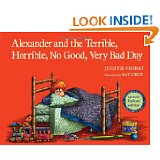
I’m having an Alexander day. A terrible, horrible, no good, very bad day where nothing goes right.

I’m sure you’ve had those days too, but you may not be familiar with the term Alexander day.

If not, you HAVE to read, Judith Voirst’s Alexander and the Terrible, Horrible, No Good, Very Bad Day. It’s a delightful children’s book that will warm your adult heart. Click on the cover to read more.

Like Alexander, I must decide what to do with this terrible, horrible, no good, very bad day.

I could grump and get nowhere with my editing or…

since I believe action can alter attitude,

I’m choosing to blog about a recent experience in a wonderful little Panhandle city called Clarendon.

For the non-Texan blog readers that would be the northernmost 26 counties in the state. The part that looks like the handle of a pan.

Panhandle counties

On our travels between Houston and Colorado, we’ve gone through Clarendon on US 287 many, many times. Not a big city. The population is under two thousand. It’s home to Clarendon College (established 1898), the oldest center of higher education in the Texas Panhandle.

On our most recent trip through, I was having another Alexander day. This time  because I had strep throat. The penicillin hadn’t fully kicked in so I was feeling pretty rotten.

We arrived in Clarendon late – 7:30 p.m. – and hungry. For all you city dwellers who think that isn’t late, small towns tend to roll up the sidewalks early.

We saw a sign for the Clarendon Steakhouse and pulled in praying it would be open. I was hoping the buffet had some soup that would soothe my very raw throat.

The building is a former grocery store converted to a restaurant with funny cowboys on the windows and friendly people inside. Very friendly and very kind people.

When we went inside, the place was about empty and the buffet was bare. My hopes sank. They were closed.

A waitress, in an apron that Vera Bradley would give her eye tooth to claim, greeted us. Turns out the waitress’ grandmother made her apron. I asked.

I explained how we were passing through, tired of driving, hungry, and really wanted some soup. Okay, I admit I shared more detail than necessary, but I am a storyteller.

She walked us to a back table to check with the owner whose name was Mary. I think. Remember I was not having a good day and that affected my memory.

Mary pointed to her husband’s soup bowl filled with the most delicious-looking chicken soup I’d ever seen. I know I looked a bit peaked and I must have drooled because Mary said she had enough for a couple of bowls.

She directed us to the “non-smoking” section. A booth at the store window under a ceiling fan. (to disperse cigarette smoke)

Sitting in the next booth was Fred Gray, a local columnist for The Clarendon Enterprise. We shared writing stories. He even went next door to the newspaper office for old editions so we could read his “The Quick, the Dead and Fred” column. Check out some of his columns in the newspaper’s online edition you’ll enjoy them.

Naturally, I shared my business card with my website and told him all about my writing. And, I’d love for you to check out my Judythe Morgan books page. :-)

Sarah, a lovely young Clarendon High School student, served as our waitress. She was excited and bubbly about her coming class trip to Washington, D.C.  Needless to say, we gave her a generous tip to go toward her expenses.

Suddenly our tiring, drive of 540 miles with another 145 more to go before we stopped had become a pleasant visit with friendly people and delicious down-home chicken soup.

And Mary wouldn’t let us pay for our dinner! Isn’t small-town America wonderful?

Sharing has helped refuel my creative juices and improved my terrible, horrible, really bad day dramatically. I’m back to editing.

YOUR TURN: What about you? How do you combat a really bad, terrible, horrible day?

1 10, 2012

I Missed National Punctuation Day. Did you?

By |2021-10-18T10:07:37-05:00October 1st, 2012|Monday Motivations, Uncategorized, writing, Writing Craft|0 Comments

Last Monday, September 24th was National Punctuation Day. Thanks, Steve Laube and Janice Heck for sharing on your blogs and putting me in the know about this yearly celebration.

I’m a week late this year, but next year I’ll be on time to celebrate the day Jeff Rubin established as the “celebration of the lowly comma, correctly used quotation marks, and other proper uses of periods, semi-colons, and the ever-mysterious ellipsis” in 2004.

Enjoy this Victor Borge skit with Phonetic Punctuation. It’s hilarious any day of the year.

On a more serious note, if you have as much trouble with punctuation and grammar as I do, I recommend:

Nitty-Gritty Grammar
A humorous guide to correct grammar.

Or for the serious student: The Elements of Style

Click on either to read more and/or add to your writer resource shelf. I’m guessing many have the Strunk and White. It’s been around as long as Victor Borge.


YOUR TURN
What’s the worst grammatical/punctuation error you’ve made or seen?

24 09, 2012

Debunking Must Dos for aspiring writers

By |2022-09-11T15:16:47-05:00September 24th, 2012|Monday Motivations, writing, Writing Craft|8 Comments

When I started writing for publication, I repeatedly heard three  must-dos if I wished to be successful. Years later with many published works, I have my own opinion about those MUSTs.

MUST #1 Write what you know.
IMO, writing what you know is easy lazy writing. I’ve done it, you’ve done. Who hasn’t?

BUT, we live in the technology age. These days you can research anything without leaving home. Or looking at it another way, we write fiction. We can make it up!

It’s been my experience, as long as my reader can suspend their disbelief and buy into my story I don’t have to be an expert about what I’m writing.

I will qualify my opinion by saying that IF you write about what you know and what interests you, your story is more likely to come alive for your reader. But sound research can produce an engaging story too.

So, don’t limit yourself to what you know. Explore. Be adventurous. Be creative. Research.

MUST #2 Never write to market.
Indie publishing has blown this MUST out of the water.

On the other hand, if you write to the traditional publishing market, you might want to AVOID market trends. By the time a manuscript is ready for what is currently trending, that trend may have died. Big Six publishers take too long from contract to reality in a bookstore. Do you really want to spend weeks, months, or even years writing a book that won’t sell?

If you’re considering indie publishing, I suggest you keep your eye on the marketplace. Publishers’ Marketplace offers deal news which is an indicator of what’s coming out. You can subscribe to the free lunch edition of Publishers’ Marketplace or spring for a paid subscription. Check regularly to see what’s trending.

Then if you need a story idea, you’ll have plenty. You might find one that appeals to you and will likely be most saleable.

MUST #3 Write the best book you can.
This one is absolutely, positively TRUE.

What sells a book or an article or a paper is CONTENT.

Agents and editors reject mediocre or unsellable submissions. Reviewers and readers will post bad reviews. So write the best, most creative, most marketable manuscript or article you can. ALWAYS!

I wish I could promise that if you follow these MUSTs you’ll find success. I can’t. There are two other elements for success in publication.

One of my early advisors – New York Times bestseller JoAnn Ross — was honest enough to share this illusive element of writing success: (paraphrased)

“Selling to traditional publishers always requires a little fairy dust.”

That’s good old fashion luck.

The other key element and critical must-have is PERSEVERANCE.

So I end by wishing you luck because every author – aspiring or established – needs a boatload of LUCK and this perseverance quote from my website writers’ resource page:

You do not know what the next effort will bring because the future is not based on the past. That feeling of wanting to give up is based solely on the past, which really doesn’t matter anymore. What matters now is where you’re headed, not where you’ve been. And when you view it from that perspective, giving up is simply not an option.” ~~~R. Marston

YOUR TURN:
What’s on your list of MUSTs for aspiring writers?

Go to Top